Digital Nomad Life in Fuerteventura
Your Real Guide to Living & Working Remotely in Corralejo
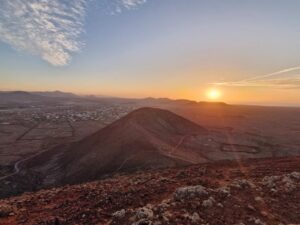
Thinking about swapping traffic, grey mornings and after-work Netflix for ocean, volcanoes and the possibility of surfing before your first call?
Fuerteventura might be a very good idea.
But let’s get something straight first: Fuerteventura isn’t Bali, Lisbon or Tenerife. And it isn’t trying to be.
There aren’t hundreds of coworking sp
aces or networking events every evening. What you get instead is space, ocean, year-round outdoor life, great conditions for water sports and a surprisingly international community of people who have chosen a slightly different way of living.
For the right person, that’s exactly the point.
Fuerteventura for Digital Nomads – The Quick Answer
Is Fuerteventura good for digital nomads?
Yes – particularly if you want a productive place to work but care just as much about what happens when you close your laptop.
- Best base: Corralejo for community + convenience + outdoor life
- Internet: Generally very good in town; always check your accommodation
- Car: Yes, if you really want to experience the island
- Community: Very active, especially through local WhatsApp groups
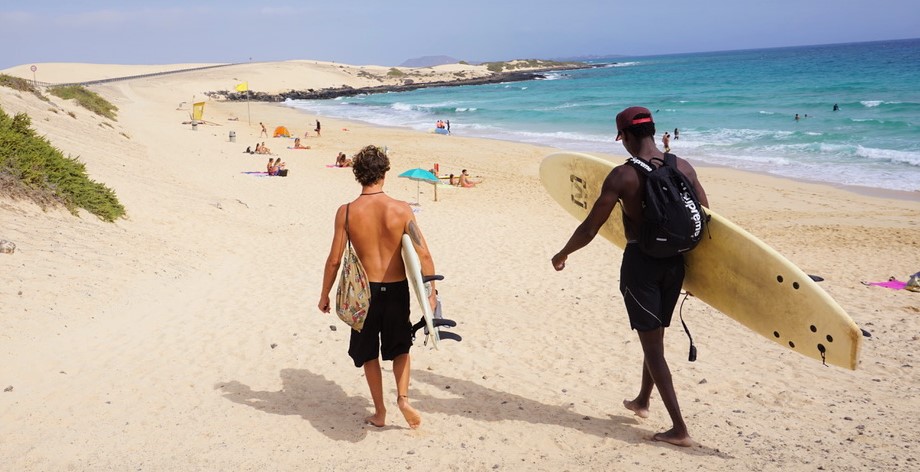
- Surf: One of the main reasons to come
- Kite: Definitely
- Best for: Solo travellers, active people, nature lovers and people staying several weeks or months
- Not ideal for: Anyone needing big-city entertainment every day
In this guide
- Is Fuerteventura good for digital nomads?
- Where should you live?
- Corralejo vs Lajares vs El Cotillo
- Internet & remote work
- Real accommodation costs
- Finding a home for a few months
- Do you need a car?
- Meeting people & community
- Solo travelling
- Coliving vs Airbnb vs hostel
- Surf, kite & life after work
- Weather & seasons
- The downsides
- Digital Nomad FAQ
01 – Is Fuerteventura good for digital nomads?
Short answer: yes. But not for every digital nomad.
Fuerteventura works particularly well if you like surfing, kitesurfing, cycling, hiking, running, yoga, outdoor training or simply being outside.
The climate means your active life doesn’t have to stop for six months of the year.
And that’s probably the biggest difference between working remotely from Fuerteventura and simply working remotely somewhere sunny.
Here, your surroundings start changing your routine.
A perfectly normal Tuesday could look like this:
07:30 – Surf
09:30 – Breakfast
10:00 – Work
17:30 – Close laptop
18:00 – Volleyball / yoga / run / beer / sunset
20:30 – Dinner with people you met three weeks ago
Or… work all day and do absolutely nothing afterwards.
That’s allowed too.
Will I like living in Fuerteventura?
You’ll probably love it if:
- Nature matters more to you than shopping.
- You’d rather meet someone surfing than at a networking event.
- You’re happiest when some form of sport sneaks into your week.
- You like small communities where faces quickly become familiar.
- You want social life, but don’t need to party every night.
- You enjoy having space.
- You’re curious about people who have chosen unconventional lives.
- You don’t mind some wind.
Actually…
You really shouldn’t mind wind.
02 – Where should a digital nomad live in Fuerteventura?
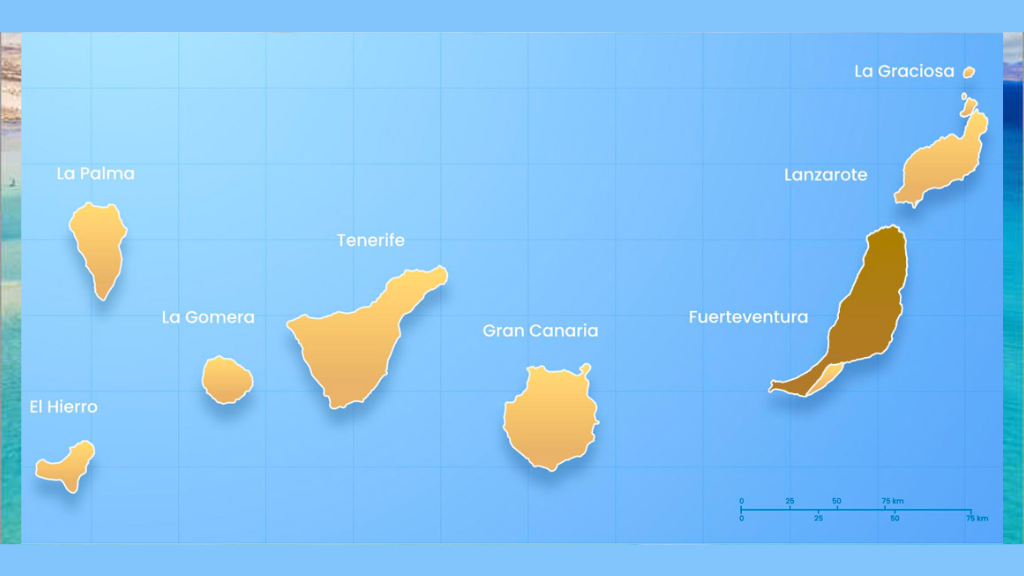
Fuerteventura is bigger than it looks on Instagram.
Where you live will completely change your experience.
For remote workers looking for a combination of community, convenience, sport and social life, we’d normally start in the north.
And particularly in Corralejo.
Why Corralejo?
Corralejo gives you something that’s surprisingly difficult to find on small islands: you can have an active, outdoorsy life without being isolated.
There are supermarkets, cafés, restaurants, bars, gyms, surf schools, kite schools and a large international community.
You can walk around town. You can go somewhere alone. You can live without a car when you don’t feel like exploring.
And then you have the dunes, volcanoes and ocean right there.
It’s touristy in parts. We won’t pretend otherwise.
But step away from the busiest streets and there’s another Corralejo where people actually live.
03 – Corralejo vs Lajares vs El Cotillo
If you’re considering northern Fuerteventura, you’ll probably end up comparing these three.
| Corralejo | Lajares | El Cotillo | |
|---|---|---|---|
| Community | ★★★★★ | ★★★★☆ | ★★★☆☆ |
| Remote work | ★★★★★ | ★★★★☆ | ★★★☆☆ |
| Surf lifestyle | ★★★★★ | ★★★★★ | ★★★★★ |
| Beach access | ★★★★★ | ★☆☆☆☆ | ★★★★★ |
| Restaurants / cafés | ★★★★★ | ★★★☆☆ | ★★★☆☆ |
| Social life | ★★★★★ | ★★★☆☆ | ★★★☆☆ |
| Quiet life | ★★★☆☆ | ★★★★★ | ★★★★★ |
| Without a car | Possible | No | Possible, but limiting |
| Prices | €€€ | €€€€ | €€€ |
Corralejo – best for community + convenience
For first-time visitors, solo travellers and people who want community without giving up convenience, Corralejo is probably the easiest option.
It’s particularly good if you want to combine work with an active lifestyle but still want restaurants, shops, gyms and social life around you.
Lajares – surf village life, but you’ll need a car
Lajares has a beautiful creative and surf-oriented atmosphere. We completely understand why people fall in love with it.
But two things are worth knowing:
It’s expensive. And you need a car.
Lajares isn’t on the beach. If surfing, kiting or spending time by the ocean is part of the plan, you’ll be driving.
It’s a great base if you want village life and already know you’ll have a car. We just wouldn’t choose it because someone described it as a convenient “surf town” where you’ll walk to the waves.
El Cotillo – beach + slow life
El Cotillo gives you the ocean much more directly.
Beautiful beaches, sunsets and a slower rhythm make it very easy to love.
You’ll have fewer options for social life, working spaces and everyday services than in Corralejo, but if tranquility comes first, that may be exactly what you’re looking for.
Coming alone for your first month? – Corralejo
Want village life and have a car? – Lajares
Want beach + slow life? – El Cotillo
04 – Can you actually work properly from Fuerteventura?
Yes.
And this surprises people.
Fiber internet is widely available in populated areas such as Corralejo, and accommodation aimed at remote workers should be capable of handling video calls and normal online work.
But don’t assume.
What should I ask my accommodation before booking?
- What is the actual Wi-Fi speed?
- Is there fiber?
- Is there somewhere comfortable to work?
- Can I take calls privately?
- Is there a backup connection?
- Is the workspace actually a workspace… or a kitchen stool?
That last one becomes surprisingly important around week three.
Do you need a coworking space?
Not necessarily.
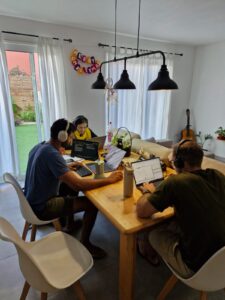
If your accommodation has a proper workspace and reliable internet, you may not want to commute somewhere else just to open your laptop.
For longer stays, we think the sweet spot is:
Good workspace at home + occasional café/coworking + lots of life outside work.
05 – How much does accommodation really cost in Fuerteventura?
This is where a lot of older digital nomad guides have aged badly.
Fuerteventura isn’t as cheap as it used to be.
Especially Corralejo and northern Fuerteventura.
If you’ve found an old article promising a lovely private apartment for €600/month in winter…
Good luck.
Rough 2026 accommodation prices
These are realistic reference ranges rather than fixed prices. Season, availability, location and how far ahead you book make a huge difference.
| Accommodation | Lower end | Higher end | Reality check |
|---|---|---|---|
| Shared hostel bed | €30-€40/night | €45-€65+ | Below €30 is unusual |
| Private room, shared bathroom | €40-€60/night | €70-€100+ | Under €40 = lucky |
| Private room + private bathroom | €55-€80/night | €90-€130+ | Strong seasonal variation |
| Studio / small apartment | €70-€110/night | €120-€180+ | Short stays get expensive quickly |
| Private apartment / house | €90-€150/night | €160-€250+ | Villas can go much higher |
| Long-stay room / coliving | €500-€900+/month | €900-€1,200+ | Usually better value for longer stays |
When is accommodation cheapest?
From our experience living here, April and May are normally among the easiest months to find better accommodation prices.
Winter is the expensive period, particularly when northern Europeans arrive looking for sunshine, surf and longer stays.
The rest of the year isn’t necessarily a dramatic “low season” either. Prices can remain surprisingly close to high-season levels.
06 – Can you rent a normal apartment for 2-3 months?
In medium and high season?
It can be very difficult.
Finding a normal private home that somebody wants to rent for only a couple of months is much harder than many newcomers expect.
Owners may prefer holiday rentals or long-term tenants, and good temporary options disappear quickly.
Summer is different.
This is one of Fuerteventura’s little contradictions.
A lot of digital nomads and international residents who live here leave during summer to visit family or spend time elsewhere.
Suddenly, apartments appear.
So while winter attracts huge numbers of people trying to escape northern Europe, summer can actually be one of the easiest periods to find a private home for a few months.
For stays of one to three months during busy periods, a coliving or accommodation specifically designed for medium stays can save you a lot of frustration.
07 – Do you need a car in Fuerteventura?
Yes.
There. We said it.
You can live in Corralejo without a car.
You can walk around town, go to nearby beaches, eat out, meet people and enjoy everyday life.
You can even surf as a beginner without one: many surf schools offer transfers and take students to whichever spot has suitable conditions.
But that’s different from really experiencing the island.
If you want to discover Fuerteventura, get a car.
The island is about exploring.
Empty beaches. Volcanoes. Tiny villages. Dirt roads. The west coast. The south. Random places somebody told you about over dinner the night before.
And if you’re an independent surfer or kitesurfer?
A car is basically a must.
Wind, swell and tides decide where you go.
Not the bus timetable.
Can I compromise and not rent a car for the whole month?
Absolutely.
Base yourself somewhere like Corralejo where you don’t need a car for everyday life, then rent or share one when you actually need it.
Car sharing between friends is also very much part of island life.
08 – Is it easy to meet people in Fuerteventura?
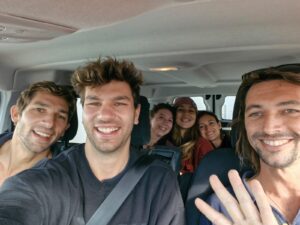
Yes. Very.
And for us, this is one of the best things about living here.
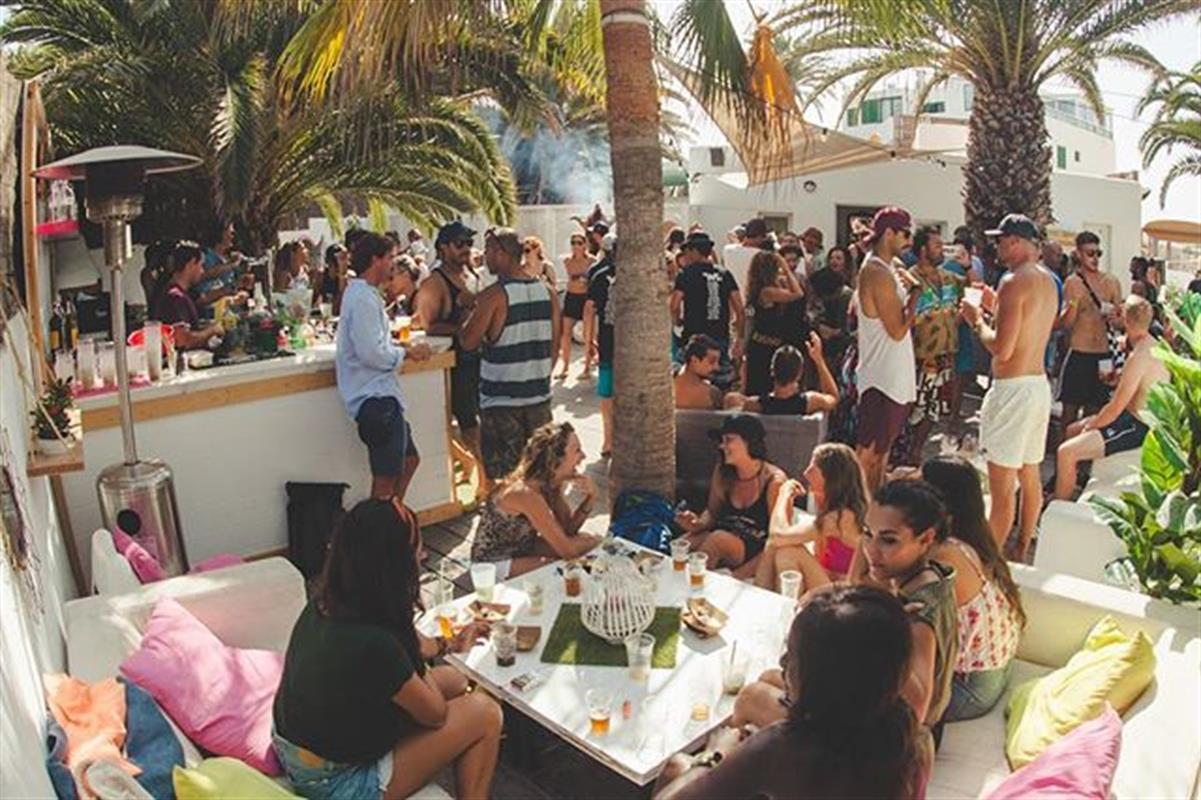
There’s a surprisingly organised social ecosystem across northern Fuerteventura.
Much of it happens through WhatsApp.
There are large groups with hundreds of people sharing plans and activities.
On any given week you might find:
- Hiking
- Beach volleyball
- Yoga
- Acroyoga
- Dancing
- Concerts
- Language exchanges
- Surf sessions
- Barbecues
- Dinners
- Spontaneous trips
- Or simply someone asking who wants a beer
And then there’s the completely unorganised side.
People are unusually open to meeting people here.
Most of us came from somewhere else.
People arrive alone. People leave. People come back. Someone is staying three weeks. Someone else came for three months and is somehow still here four years later.
The social rules are different from cities where everyone has had the same friendship group since university.
Going somewhere alone isn’t weird.
Talking to someone you don’t know isn’t weird.
Joining a plan where you know exactly one person isn’t weird.
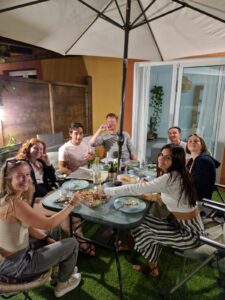
You can genuinely go out alone for a beer and end up at a table with six people who somehow feel surprisingly similar to you.
And that’s pretty special.
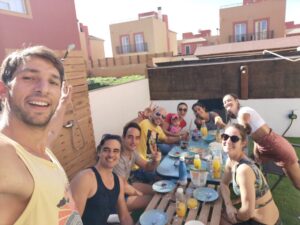
Meet our Social Glue.
Not an entertainer. Not your mum. Not someone chasing you around with an activity schedule.
Our Social Glue is simply someone who helps people connect.
They share what’s happening, introduce people, open doors to the local community and, when they’re around, normally get a couple of plans moving each week.
Guests staying at Casa Las Dunas can also get access to some of the local WhatsApp communities we use ourselves.
And then…
We let humans do their thing.
People organise dinners. Someone asks who wants to surf. Someone has a car and suggests an adventure. Someone else wants to practise yoga. Five people suddenly decide to go for a beer.
So… will there always be someone organising things?
No. And we’d rather be honest about that.
Our Social Glue isn’t guaranteed to be physically around 100% of the time.
Sometimes a house clicks immediately. Sometimes everyone is working like crazy. Sometimes people want their own space.
That’s communal living.
What we do promise is that human connection isn’t an accidental side effect of Casa Las Dunas.
It’s something we actively care about.
Our kind of weird.
When we first arrived in Fuerteventura, something surprised us even more than the beaches.
The people.
Outside places like this, finding new friends as an adult who really get you can be weirdly difficult.
Here you suddenly find surfers, travellers, entrepreneurs, yogis, vanlifers, remote workers, adventurers and people who at some point decided that perhaps the standard big-city script wasn’t quite for them.
A slightly unusual collection of curious, adventurous humans.
Our kind of weird.
Maybe yours too.
09 – Is Fuerteventura good for solo travellers?
Very.
Especially if you’re willing to say yes to things.
Your accommodation matters enormously, though.
If you rent a beautiful private apartment, close the door after work every evening and wait for friendship to knock…
You might be waiting a while.
Instead:
- Stay somewhere communal.
- Join the WhatsApp groups.
- Take a surf lesson.
- Go to yoga.
- Join that hike.
- Say yes to the random beer.
Many people here arrived alone.
That makes joining in considerably easier.
10 – Coliving, hostel or private apartment?
There’s no right answer.
It depends on what you want from your stay.
| Hostel | Private apartment | Coliving | |
|---|---|---|---|
| Privacy | ★☆☆☆☆ | ★★★★★ | ★★★★☆ |
| Easy to meet people | ★★★★★ | ★☆☆☆☆ | ★★★★★ |
| Good for working | ★★☆☆☆ | ★★★★☆ | ★★★★★ |
| Long stays | ★★☆☆☆ | ★★★★☆ | ★★★★★ |
| Spontaneous plans | ★★★★★ | ★☆☆☆☆ | ★★★★★ |
| Personal space | ★☆☆☆☆ | ★★★★★ | ★★★★☆ |
A hostel can be great if budget and socialising are your priorities.
A private apartment is perfect if independence and privacy matter most.
A coliving sits somewhere in between.
You can close your bedroom door when you need your own space, but you don’t necessarily have to eat dinner alone every evening.
For solo travellers staying several weeks or months, we think that balance is particularly valuable.
We may be slightly biased.
11 – What do you actually do after work?
This is the whole point.
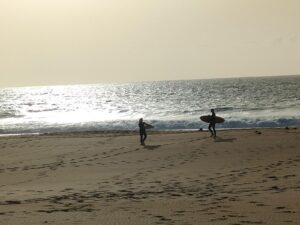
🏄 Surf
Northern Fuerteventura offers everything from beginner-friendly sessions to serious waves.
Staying several weeks changes the experience completely.
You don’t have to surf because:
“It’s Tuesday and I booked surfing for Tuesday.”
You wait for conditions.
Then you go.
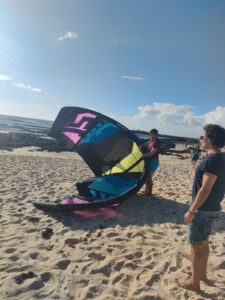
🪁 Kite & wind sports
Fuerteventura is internationally known for wind sports for a reason.
Kitesurfing and windsurfing are a huge part of island life, particularly when the wind gets stronger.
If you’re learning, go with a proper school.
The ocean doesn’t care how many YouTube tutorials you watched.
🥾 Volcanoes & hiking
Fuerteventura isn’t lush.
It’s raw.
Volcanoes, desert landscapes, cliffs, dirt tracks and enormous skies.
Some people arrive expecting tropical greenery and don’t understand the landscape immediately.
Give it time.
🚴 Cycling, running & outdoor training
Open roads, dry weather and endless trails make outdoor training easy to build into everyday life.
And after spending most of the day staring at a screen, getting outside and moving is one of the best parts of living here.
🧘 Yoga & movement
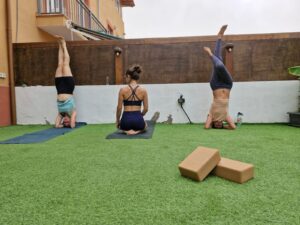
Yoga fits naturally into the lifestyle here, alongside acroyoga, outdoor training and other community activities.
Some weeks you’ll have a perfectly organised routine.
Other weeks somebody will suggest sunset yoga and dinner afterwards.
Both work.
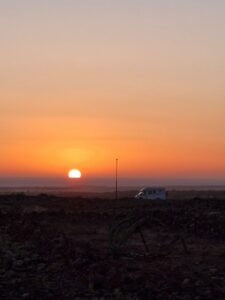
🌅 Absolutely nothing
Also highly recommended.
Grab something cold.
Find somewhere facing west.
Watch the sun disappear.
12 – What’s the weather actually like?
Yes, Fuerteventura has great weather.
No, that doesn’t mean it’s 27°C with zero wind every day.
The wind
It’s part of the island.
Sometimes wonderful.
Sometimes annoying.
Sometimes the entire reason someone next to you flew here with €3,000 of kite equipment.
Calima
Occasionally Saharan dust reaches the Canary Islands, creating hazy skies and warmer temperatures.
Winter evenings
They can feel surprisingly fresh, especially with wind.
Bring a jumper.
Your Instagram research may have omitted this information.
When should digital nomads come to Fuerteventura?
It depends on what you want.
| Period | Why come? | Accommodation |
|---|---|---|
| Winter | Escape European winter, surf, active community | $$$$ |
| Spring | Great balance of weather, activity and availability | $$-$$$ |
| April-May | Often better accommodation value | $$ |
| Summer | Wind sports + easier temporary housing opportunities | $$-$$$ |
| Autumn | Surf + active island life | $$$ |
Is one month too long in Fuerteventura?
No.
Actually, we’d argue the opposite.
Fuerteventura isn’t an island you need to “complete”.
There aren’t 47 monuments you have to check off before flying home.
The best bits are ordinary.
Finding your beach. Knowing which bakery you like. Recognising people around town. Understanding where to go depending on the wind. Surfing before work because today happens to be good.
Getting a message saying:
“Sunset beer?”
…and knowing exactly where everyone means.
Two days
You’ll see Fuerteventura.
Two weeks
You’ll start understanding it.
One month
You’ll start living here.
13 – What are the downsides of living in Fuerteventura?
We love this island.
That doesn’t mean you will.
Fuerteventura might NOT be for you if…
- You hate wind.
- You need big-city culture.
- You want endless restaurants and nightlife.
- You expect tropical greenery.
- You don’t drive and want to explore independently.
- You need constant entertainment.
- You expect everything to happen immediately.
Parts of Corralejo are also very touristy.
That’s real.
But walk or drive away from those areas and the island changes incredibly quickly.
Fuerteventura works best when you stop asking it to entertain you.
You create your own life here.
Fuerteventura vs Tenerife or Gran Canaria for digital nomads
If your priority is a large city, huge coworking ecosystem, endless restaurants, nightlife and cultural events:
Look at Tenerife or Gran Canaria.
If your priorities are:
Ocean. Space. Surf. Kite. Nature. Sport. Outdoor life. Smaller communities.
Fuerteventura starts making much more sense.
We’re not interested in convincing everyone that Fuerteventura is the “best Canary Island for digital nomads”.
It isn’t.
It’s the best one for certain people.
We happen to really like those people.
Digital Nomad Fuerteventura – FAQ
Is Fuerteventura good for remote work?
Yes. Corralejo in particular combines good internet infrastructure with an international community and a very active outdoor lifestyle.
Where is the best place for digital nomads in Fuerteventura?
Corralejo is generally the easiest base if you want community, services, restaurants, sport and social life. Lajares offers quieter village life but is expensive and requires a car. El Cotillo works well for people prioritising beaches and a slower pace.
Do I need a car in Fuerteventura?
For everyday life in Corralejo, no. To properly explore the island or surf and kite independently, yes. We’d strongly recommend one.
Is Fuerteventura good for solo travellers?
Very. Northern Fuerteventura has an international population, active WhatsApp communities, sports groups and a culture where meeting new people is very normal.
How much is accommodation in Corralejo?
A shared hostel bed commonly costs €30+ per night, while finding a private room below €40 is increasingly difficult. Longer-stay rooms and colivings can offer considerably better monthly value.
Can I find an apartment for one or two months?
It’s possible, but difficult during medium and high season. Summer can surprisingly be easier because some international residents and digital nomads temporarily leave the island.
Is Fuerteventura expensive for digital nomads?
It’s no longer the extremely cheap destination described in older guides. Accommodation has risen substantially. Your overall budget will depend heavily on accommodation, car rental, eating out and whether you rent surf or kite equipment.
Can I surf and work remotely from Fuerteventura?
Absolutely. Staying longer is actually one of the best ways to surf here because you can adapt your sessions to swell, wind and tides instead of forcing them into a short holiday.
Is Corralejo walkable?
Yes. You can handle most everyday life on foot. A car becomes important when you want to explore beyond town.
How long should a digital nomad stay in Fuerteventura?
If you’re working remotely, we’d recommend several weeks rather than a few days. A month gives you enough time to develop a routine, meet people and start becoming part of the community.
Work. Go outside. Repeat.
We don’t think digital nomad life in Fuerteventura is about putting a laptop beside a swimming pool.
Direct sunlight is terrible for your screen anyway.
It’s about having a normal, productive working day…
…and an abnormal amount of life waiting outside when you’re done.
At Casa Las Dunas, we’re in a quiet residential part of Corralejo, right in front of the dunes.
Close enough to town to be part of the community.
Far enough away to switch off.
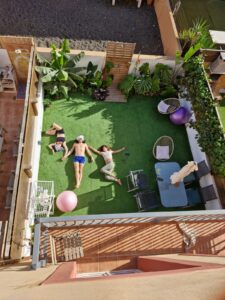
There’s fast Wi-Fi, places to work, terraces, space for your surf gear and a small international community.
Some people come for surf.
Some for kite.
Some arrive alone.
Some just want winter to disappear.
Some stay longer than expected.
We can’t promise who you’ll meet.
We can’t promise what the waves will do.
And our Social Glue won’t be standing there with a clipboard waiting to entertain you.
What we can do is make it easier to arrive, connect and discover the Fuerteventura we’ve fallen in love with ourselves.